
Tuning In: Connecting to the Moon
Every night the moon rises, it brings with it something quietly transformative. Connected to flow, creativity, and the feminine principle, the moon is one of the great cosmic forces closest to us — shaping the tides, cycling through light and dark, and affecting us in ways both subtle and profound. Here are some ways rooted in ancient wisdom to connect and harmonize with its energy.
Connecting to its orbit: Māsa
The moon's months can be counted using two distinct cycles:
Sidereal month — the time it takes the moon to complete one full orbit around the Earth, point to point: approximately 27 days, 7 hours, and 43 minutes.
Synodic month — the time it takes to complete one full cycle from new moon to new moon, with the moon positioned directly between the Earth and Sun: approximately 29 days, 12 hours, and 44 minutes. This is the month used in Vedic astronomy to track the full cycle of waxing and waning.
Why the distinction? Because the Earth is not still. As it moves around the Sun while the moon orbits the Earth, the time for a pure 360-degree orbit differs from the time for a complete light cycle. Both are used to track different aspects of time.
Connecting to its daily flow: Tithi
Tithi is the Vedic system for tracking the moon's daily movement — measuring the exact geometric relationship between the Sun and Moon in increments of 12 degrees. Each time the Moon travels 12 degrees further from the Sun, one tithi is complete.
This system tracks the waxing and waning of the moon with mathematical precision. Rather than the 8 phases of the Western system, the Vedic system identifies 15 distinct tithis per cycle.
Thirty tithis complete one synodic month.
The 15 tithis are:
Pratipada
Dwitiya
Tritiya
Chaturthi
Panchami
Shashthi
Saptami
Ashtami (Half Moon)
Navami
Dashami
Ekadashi
Dwadashi
Trayodashi
Chaturdashi
Purnima (Full Moon) / Amavasya (New Moon)
Shukla Paksha — the waxing phase, or bright fortnight
Krishna Paksha — the waning phase, or dark fortnight
Connecting to its qualities: Spiritual Frameworks
There are three major frameworks for understanding the moon's energetic qualities and their relationship to the human being — the Vedic, the Vaishnava, and the Tantric. Each maps to the 16-fold structure of the lunar cycle: 15 tithis expressing distinct qualities, and one unseen generative principle that underlies the whole cycle of waxing or waning. Each offers a distinct angle of understanding and a distinct mode of practice. All three converge on the same underlying principle: that the changing light of the moon transmits specific qualities of consciousness, and that attuning to those qualities — through knowledge, practice, and visualization — transforms the practitioner.
The Vedic framework — 16 aspects of the being
The Praśna Upanishad and the Atharvaveda tradition map the moon's 16 phases to 16 constitutive aspects of the Puruṣa — the principle of conscious being. Puruṣa, while linguistically associated with the masculine principle, does not refer to male or female — it is the principle of awareness itself, the conscious ground that inhabits and animates a living being.
The teaching works by analogy: just as the moon expresses sunlight in 15 distinct phases before the 16th hidden phase absorbs them all back at the new moon, a living being expresses its core awareness through 15 distinct faculties before they are absorbed back at death, and re-emerge at birth. The Upanishad uses this image to map what a human being is actually made of — not metaphorically, but as a precise account of the constitutive elements of embodied conscious life. We start off as a seed of consciousness that grows into being, and then the being fades, the consciousness merges back into its source.
These 16 aspects are:
Prāṇa — life force, the animating breath
Śraddha — faith, the capacity for trust and receptivity
Ākāśa — space, the element of infinite openness
Vāyu — air, the element of movement and breath
Agni — fire, the element of transformation and heat
Ap — water, the element of flow and cohesion
Pṛthvī — earth, the element of solidity and form
Indriya — the sense faculties, the capacity to perceive
Manas — mind, the thinking and processing faculty
Anna — food/nourishment that becomes the body, the material sustenance of life
Vīrya — vital power, potency, the generative life force
Tapas — austerity, inner heat, concentrated spiritual energy
Mantra — sacred sound, the power of the word
Karma — action, the accumulated force of what has been done
Nāma — name and identity, the individual designation
Amṛtā — the deathless ground into which all 15 dissolve at death and from which they re-emerge at birth
The list moves from the most subtle (Prāṇa, Śraddha) through the five elements (Ākāśa through Pṛthvī) into the faculties of the embodied being (Indriya, Manas) then into what sustains and refines that being (Anna, Vīrya, Tapas) and finally into what gives it form and continuity (Mantra, Karma, Nāma). It is a complete map of what a human being actually is — from the breath that animates to the name that identifies.
The Vaishnava framework — 16 Kalās of the complete being
In the Vaishnava tradition, Krishna — born of the lunar dynasty, his very name meaning the dark one — is understood as the Pūrṇa Avatāra, the complete descent, the being who embodies all 16 Kalās simultaneously and fully. Śrī Rāma, also an Avatāra, carries the energy of the Sun — born into the solar dynasty, embodying its 12 qualities as the ideal human being. Each exemplifies a different energetic principle lived fully in human form, offering a living map of how these energies can be realized within us. The 16 Kalās of Krishna describe not the constitutive elements of an ordinary being but the qualities and powers of one who is complete.
This framework offers two complementary lenses: the energies carried, and the qualities expressed.
The 16 energies (Śaktis):
Śrī — abundance, radiance, divine grace; the quality of auspicious fullness that draws all toward it
Bhū — stability, groundedness, the sustaining power; the earth principle that holds and supports all that arises
Kīrti — fame, glory, renown; the quality of being known throughout all worlds as the expression of what is highest
Ilā — the energy of speech and earth; the power of inspired expression that moves between the cosmic and the earthly
Līlā — divine play; spontaneous creative expression unconstrained by purpose or outcome — action as pure delight
Kānti — beauty, lustre, charm; the quality of luminous attractiveness that radiates from a being of complete inner fullness
Vidyā — knowledge; not mere information but the direct knowing that arises from identity with what is known
Vimalā — purity, cleansing; the quality of absolute transparency — nothing obscuring, nothing distorting, nothing held
Utkarṣiṇī — the uplifting energy; the capacity to elevate whatever comes into contact with it toward its highest expression
Jñāna — wisdom; the integrated knowing that holds all experience within a single understanding
Kriyā — action, doing; the power of precise and effective movement in the world — action that accomplishes without residue
Yoga — union, focus; the capacity to hold all things in relationship to the one ground from which they arise
Prahavī — creation, expansion; the generative power that brings new forms into being from the inexhaustible source
Satya — truth; absolute alignment between what is, what is known, and what is expressed — no gap anywhere
Īśnā — sovereignty, the capacity to govern; the power of supreme authority that flows from completeness rather than from force
Anugraha — grace, blessing; the freely given gift that asks nothing in return — the final and most complete expression of what all the other Kalās build toward
The 16 qualities expressed:
Daya — compassion; the quality of meeting every being where they are, without judgment or condition. Not pity, which looks down, but genuine care that sees the other as oneself.
Dhairya — patience; the unwavering composure that holds steady through difficulty without being diminished by it. The capacity to remain rooted when everything around is turbulent.
Kṣamā — forgiveness; the ability to release the hold of what has been done to you — not because it didn't matter, but because your freedom is more important than your grievance.
Nyāya — justice; the commitment to right order over personal advantage. Not revenge, which is personal, but justice, which restores the integrity of the whole.
Nirapekṣa — impartiality; the quality of relating to all beings from the same ground, without preference distorting perception. What you feel for one, you hold equally for all.
Nirāsakta — detachment; the capacity to move through joy and sorrow, gain and loss, praise and blame — fully present to each — without being defined or destabilized by any of it.
Tapasyā — inner fire; the concentrated spiritual energy that comes from sustained discipline and practice. Not willpower alone, but the refinement of the whole being through sustained attention.
Aparājita — invincibility; the quality of being fundamentally undefeatable — not because nothing touches you, but because nothing that touches you reaches the ground of what you are.
Dānasheela — generosity; the natural overflow of a being who knows themselves to be complete. Giving not from surplus but from abundance that cannot be depleted.
Saundaryamaya — beauty; not only in form but in the totality of expression — the beauty of a being whose inner and outer life are fully aligned and radiant with that alignment.
Nṛtyajña — mastery of dance; the capacity to move in complete harmony with the rhythm of existence — to be so present in the body that movement itself becomes an expression of the divine.
Saṅgītajña — mastery of music; the power to touch what is deepest in another through sound. Not technical skill alone but the capacity to transmit a living quality through the medium of music.
Nītivādī — ethical integrity; living in complete alignment between inner knowing and outer action. Not rule-following but the natural expression of a being whose values and conduct are one.
Satyavādī — truth; the embodiment of absolute alignment — between what is, what is known, and what is expressed. No gap anywhere between the seen and the said.
Sarvajñatā — omniscience; mastery across all domains of knowledge and art. Not merely expertise but the integrative understanding that holds all knowledge as one field.
Sarvaniyantā — sovereign self-governance; the capacity to govern the whole from the center — beginning with the self, and extending naturally outward from that mastery.
A note on sourcing: both Kṛṣṇa Kalā lists circulate in Vaishnava educational and devotional literature. The underlying doctrinal claim — that Krishna as Pūrṇa Avatāra embodies all 16 Kalās — is well attested in the Puranic tradition. The specific named lists from different sources give some variations. The most popular lists are included here as frameworks for contemplation rather than as fixed canonical lists.
The Tantric Devī framework — Moon energy as the feminine principle
Why the moon’s energy represents the feminine principle
The visualization is precise and beautiful: during the waxing moon, a light Goddess is said to leave the Sun and take her place upon the moon each day, joining and merging with the one before her. During the waning phase, a light Goddess departs each day, and the remaining light is held by the Goddess before her. This mirrors exactly how moonlight works — the moon reflects the Sun's light, and what we see is the changing angle and proportion of that reflection.
The moon's light is reflected, not self-generated — and this is not a diminishment but a profound teaching. In the Vedic framework, energy can only be perceived when matter reflects it. The Sun's direct light is Prakāsha — pure radiant awareness. The colors that emerge from its reflection are Vimarśa — the creative, expressive dimension. The Sun's energy is Gāyatrī; the reflected light of the waxing and waning moon unfolds as the creative spectrum of existence, with red — the longest and slowest visible wavelength — ascribed to Goddess Lalitā Tripura Sundarī, the Goddess of the full moon. This is why red symbolizes the auspiciousness and blessing of the Goddess.
This does not suggest the feminine is merely derivative of the masculine. It points to something subtler: energy is the underlying substrate that moves all matter. In order to be perceived, it must be reflected. The feminine principle is not the reflection — it is the force that makes anything move at all. Without her will, nothing happens.
Honoring Light (Sri Kula) and Dark (Kali Kula)
Two great schools of feminine principle worship relate directly to the moon's cycle:
Srī Kula tracks the light — what comes and goes with the waxing phase. Its presiding Goddess is Lalitā Tripura Sundarī: the brilliant, radiant, most balanced expression of creation at its highest vibration. A practitioner of Srī Kula attunes to and awakens this frequency within themselves.
Kālī Kula honors the darkness — what is always present, what holds space when light recedes. Its presiding Goddess is Kālī: the force of transformation, unconditional love, rebirth, and naked truth. The dark side of the moon — what persists beneath the appearance of light — takes precedence in this path. A practitioner of Kālī Kula attunes to and awakens this frequency within themselves.
There is also a third, rarer path: Kālī Kula Srī Vidyā, which tracks the light during the waxing phase and the dark during the waning. This is considered an advanced practice because it requires the ability to attune to both energies and shift fluidly between them — holding both light and dark simultaneously rather than cultivating one in focused depth.
16 Nitya Devis - 15 Daily Goddesses + 1 Presiding Goddess
The number 16 is the sacred numerical basis of the moon and the feminine principle. There are 16 Kalās — qualities of light — ascribed to each phase of the moon's cycle, and the overarching deity that of light or darkness that is the central figure of the spiritual tradition. It is not a visible tithi in the sky, but rather the one who is the ultimate representation of the fullest form of light or dark.
Corresponding to these 16 qualities are the 16 Nitya Devīs — the daily Goddesses. Each tithi is presided over by one of these Goddesses, with the 16th assigned to the overarching Goddess of the concept at hand.
Sri Kula Nitya Devis:
Lalita Tripura Sundari
Kāmeśvarī
Bhagamālinī
Nityaklinna
Bheruṇḍā
Vahnivasini
Vajreśvarī
Śivadūtī
Tvaritā
Kulasundarī
Nityā
Nīlapatākā
Vijayā
Sarvamangalā
Jvālamālinī
Citrā
Kali Kula Nitya Devis:
Kālī
Kālī
Kapālinī
Kullā
Kurukullā
Virodhinī
Vipracittā
Ugra
Ugraprabha
Dīpā
Nīlā
Ghanā
Balakā
Mātrā
Mudrā
Mitā
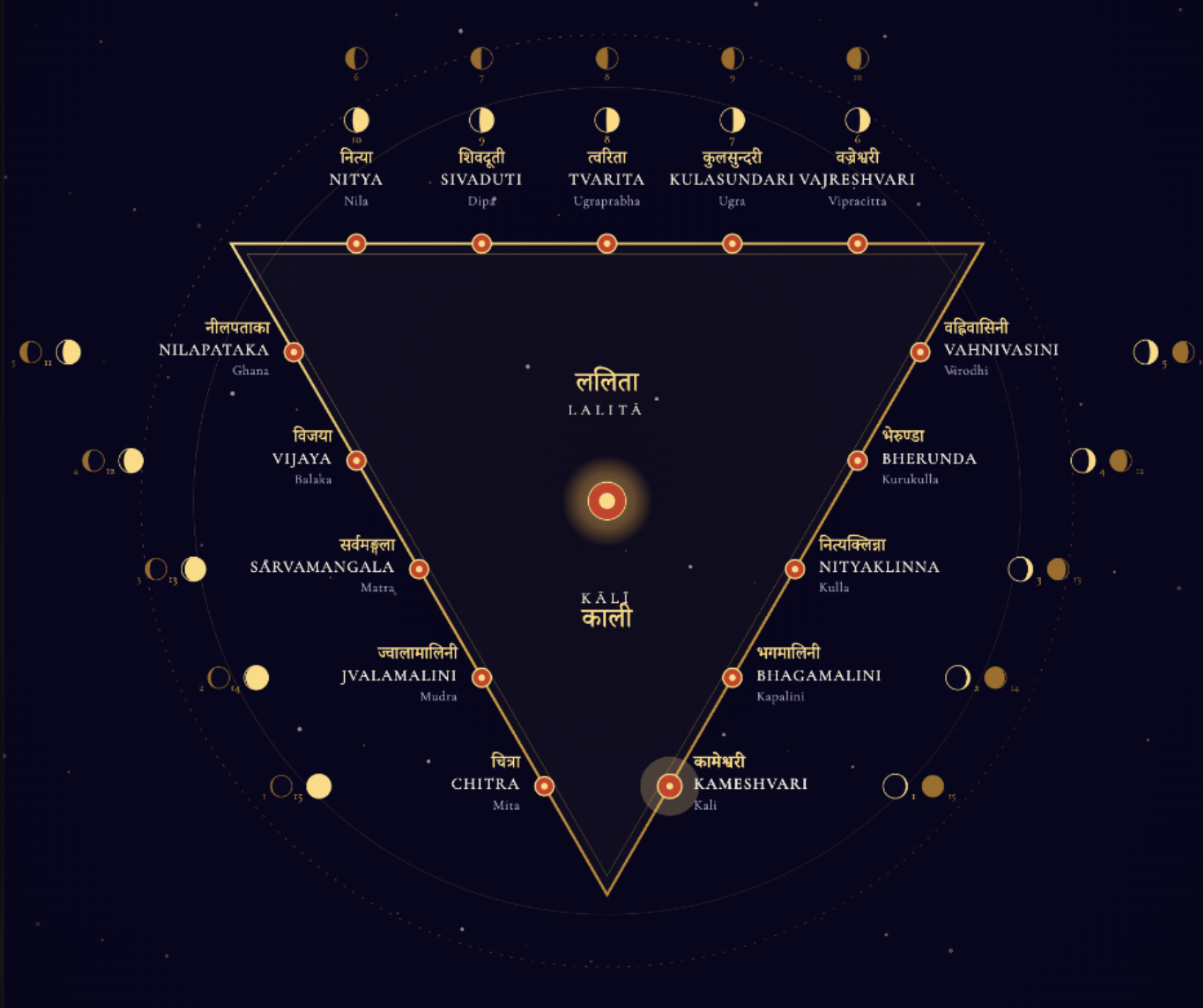
16 Kalas - Qualities of light
The number 16 is taken as a basis as a representation of the moon, and the feminine principle. There are 16 Kalas or qualities of the moon - ascribed as per the quality of light each day.
They are:
Mānada — honour, dignity, the quality of being worthy of regard
Pūṣā — nourishment, the sustaining and causing to thrive
Tuṣṭhi — contentment, inner satisfaction, the quality of being at peace with what is
Puṣṭhi — flourishing, robust growth, the quality of being fully nourished and thriving in body and being
Ratī — delight, pleasure, the quality of deep enjoyment and loving absorption
Dhṛuti — steadiness, resolve, the quality of holding firm without wavering
Śaśinī — the cool luminous quality of moonlight, gentle and silvery radiance
Candrikā — the diffused spreading glow of moonlight, the quality of soft light filling the night
Kāntā — beauty, charm, the quality of being radiant and deeply desirable
Jyotsnā — the full luminous brightness of a moonlit night, the quality of being flooded with cool white light
Śrī — radiance, auspiciousness, beauty, and abundance all at once — the quality of grace in its fullest expression
Prīti — love, affection, tender gladness, the quality of joyful loving connection
Aṅgadā — adornment, the quality of fullness and completeness of form — that which embellishes and brings to wholeness
Pūrṇā — fullness, completeness, the quality of being entirely whole — nothing lacking, nothing in excess
Amṛtā — immortality, the quality of being beyond death and decay
Purṇāmṛtā — the fullness that is deathless; complete wholeness that is also immortal
Full table of Goddesses, Kalas, and Tithis
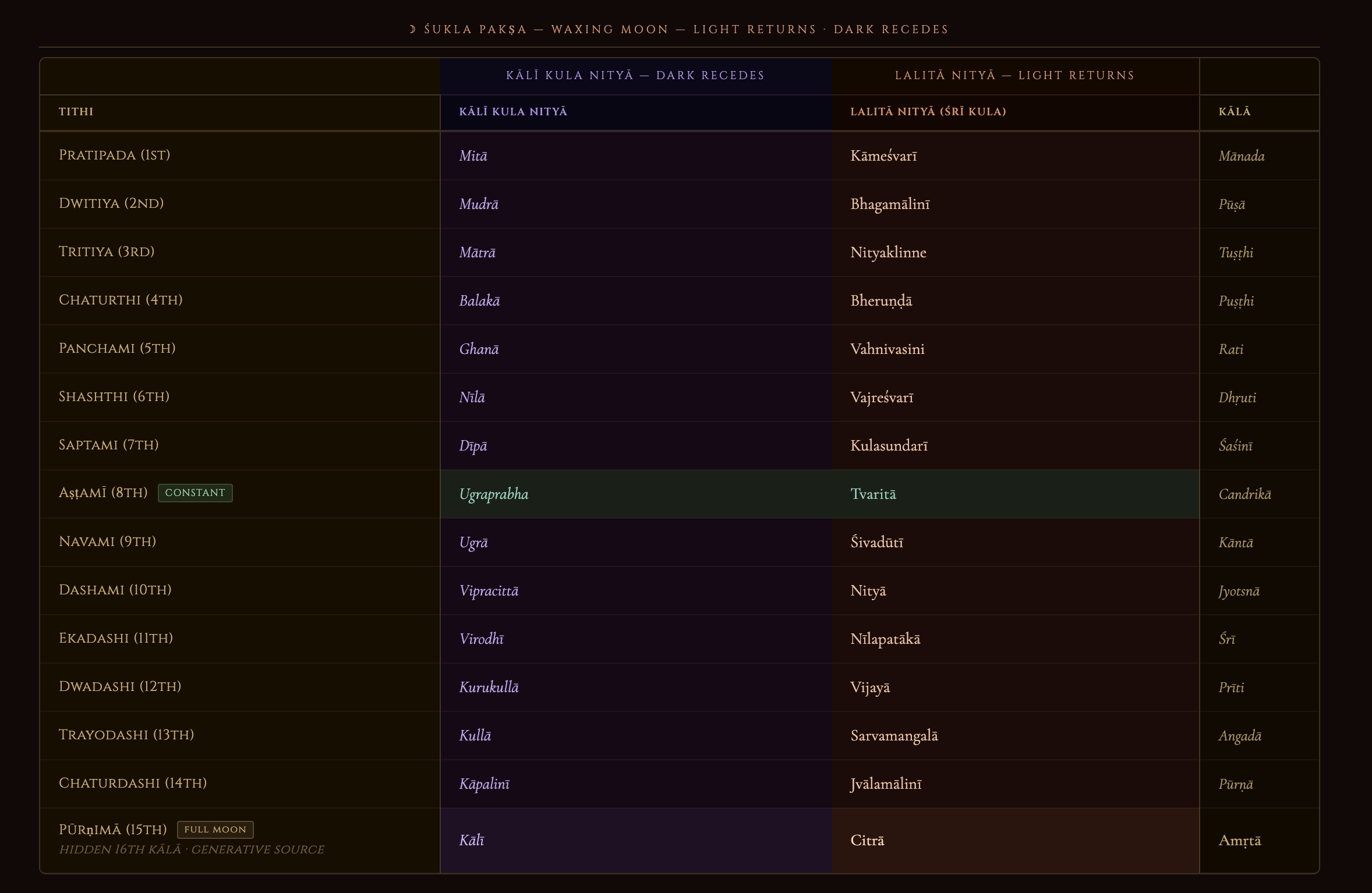
Sukla Paksha
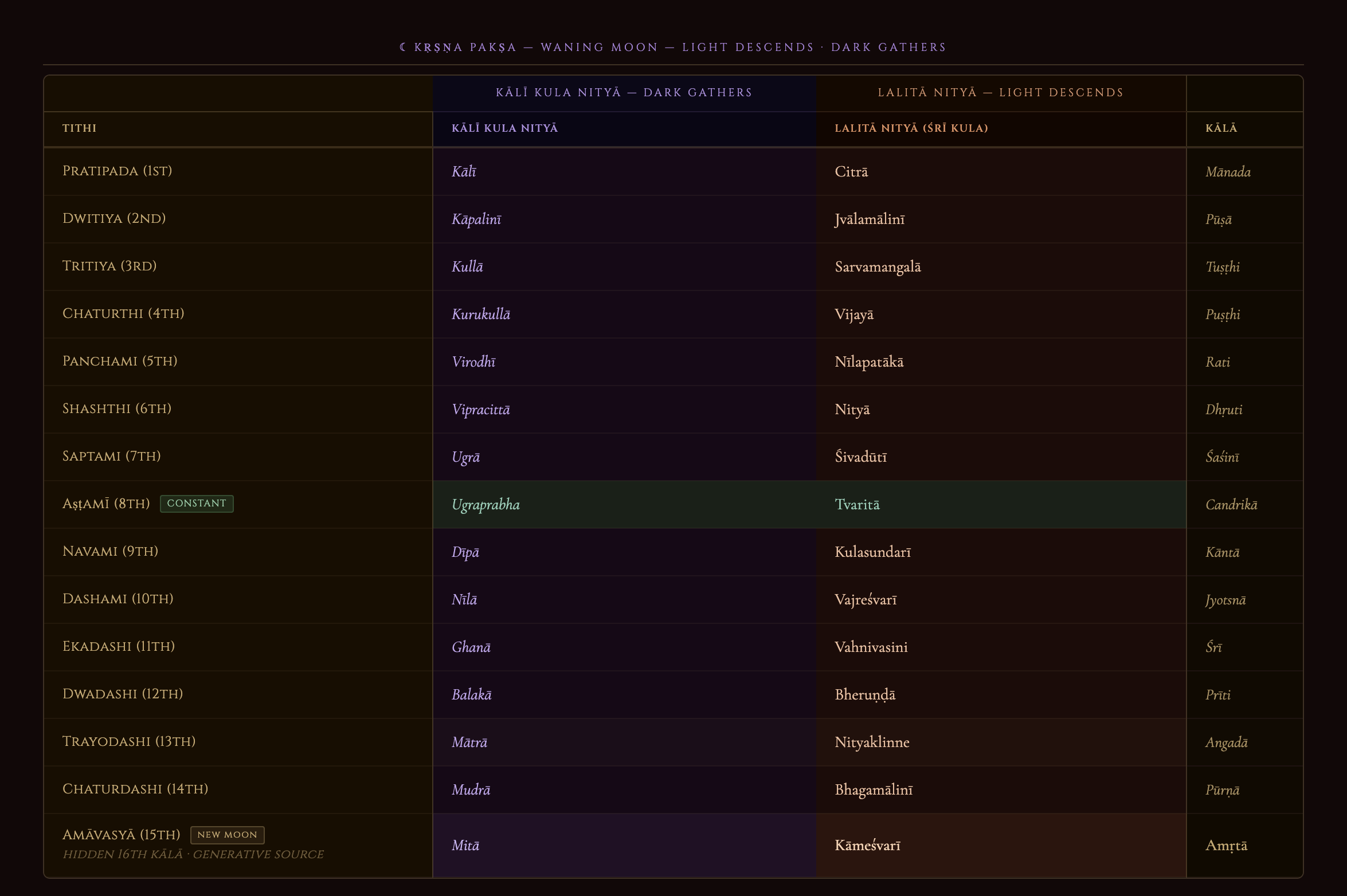
Krishna Paksha
Connecting to its energy in the body: Chandra Namaskar, Mantras
Chandra Namaskar:
Just as the Sūrya Namaskār attunes to the energy of the Sun through 12 movements on each side — corresponding to the 12 hours of the day and the 12 signs of the zodiac — the Chandra Namaskār honors the Moon through 16 movements per side, corresponding to the 16 Kalās. Where the Sūrya Namaskār moves vertically, front to back along the mat, the Chandra Namaskār moves horizontally — standing sideways along the long edge of the mat, oriented side to side.
Mantras:
Mantra is one of the most direct tools for attuning to the moon's energy. Some to begin with:
Chandra Mantras — mantras addressed directly to the moon, connecting to its physical presence and gravitational influence on the body and mind.
Lalitā Sahasranāmam — the thousand names of the Goddess Lalitā, particularly suited to the full moon tithi, when her light is at its fullest expression.
Khadgamālā Stotram — the sword garland of Śakti, invoking each of the Goddesses of the Śrī Yantra in sequence, traversing all nine enclosures from the outermost to the Bindu.
Kālī Sahasranāmam — the thousand names of the Goddess Kālī, particularly suited to the new moon tithi, when her darkness is most present and the power of transformation most available.
Nitya Devī Mantras — mantras invoking each Nitya Devī individually, used to attune to the specific quality of light or darkness carried by the day's presiding Goddess.
There are more tradition-specific and practice-specific mantras beyond these — these are a starting point.
Yantras:
The Srī Yantra — the most comprehensive geometric symbol in the tradition, into which all other Yantras resolve — represents the full moon and Lalitā Tripura Sundarī. Meditating on it, keeping one in your home, or wearing one as a talisman supports attunement to the creative, radiant principle.
The Kālī Yantra represents the new moon: transformation, rebirth, unconditional love, and truth that lives beneath all appearance. Working with it cultivates the capacity to hold space for darkness with love — and to find what is real on the other side of it.
The Nitya Devī Yantras each correspond to one of the 16 daily Goddesses. Meditating on the yantra of the day's Nitya Devī can attune you to the specific quality of light or darkness she holds.
Raagas:
Certain Rāgas carry a direct resonance with the moon's energy. The Kauns family — most notably Chandra Kauns — is directly associated with the moon's cool luminous quality. The Kedar family carries a different dimension of lunar energy — the moon as held by Śiva in the Vedic cosmological framework, the crescent on the brow of the ascetic, the stillness that holds the flood of the Gaṅgā.
In Essence
Attuning to the moon is not merely symbolic. The moon's changing light affects the waters of the Earth, the biology of living systems, the body's sleep cycles, mood, mental health, and creativity. This is why the moon is so intimately connected to the mind — and to the imagination, the inner life, and the feeling body.
Practices for attuning:
Chandra Namaskār — awakening and harmonizing with lunar energy in the body and breath, meditating on the 16 aspects of being and the qualities they represent.
Tithi tracking — following the moon's daily movement through its waxing and waning cycles, and orienting your attention to the quality of the day.
Devī attunement — connecting to the day's Nitya Devī and the specific quality of light or darkness she carries.
Yantra meditation — using sacred geometry as a focal point for attuning to the energetic principle each symbol represents.
Rāga sound journey — using the Rāgas associated with the moon to bring the mind into resonance with the energy of the lunar moment.
The moon has always been a teacher of rhythm, reflection, and return. These practices are simply ways of learning to listen.